
energy
Stanford University: Acoustic waves biocells medicine’s experiments
Stanford cardiologists just did the impossible using acoustics to grow new healthy heart tissue. Peer Reviewed. Irrefutable Proof At Stanford University, cardiologist Sean Wu, MD, PhD and acoustic bioengineer Utkan Demirci, PhD are pioneering acoustofluidic tissue engineering — using high-frequency sound waves to pattern living heart cells into functional tissue structures.
“Future medicine will be the medicine of frequencies » – Albert Einstein
What have they proven so far, according to their peer-reviewed research?
• They generate standing bulk acoustic waves inside a microfluidic gel containing suspended cardiomyocytes (heart muscle cells).
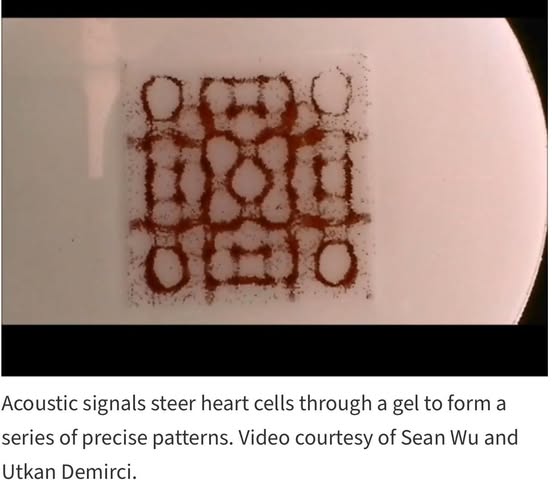
• These waves create pressure nodes that steer the cells into highly organized, repeatable geometries — cymatic patterns — that resemble the alignment found in healthy myocardium.
• By precisely tuning the frequency and amplitude, they control how cells align, connect, and contract together, mimicking native heart tissue architecture.
• This method is non-contact, scaffold-free, and more gentle than traditional bioprinting or micromanipulation.
Cell alignment and connectivity are critical for creating tissue that actually beats in sync with the heart — without this, engineered patches can’t function properly.
Here’s what this looks like in the lab:
“Heart cells being steered by high-frequency acoustic waves into a precise cymatic pattern inside a gel matrix. This shows how standing bulk acoustic waves generate pressure nodes that position the cells in organized, tissue-like structures — a key breakthrough in Stanford’s acoustofluidic cardiac regeneration research.
Courtesy: Sean Wu, MD, PhD and Utkan Demirci, PhD — Stanford Medicine.”
The bigger vision?
• Grow functional cardiac patches to repair tissue damaged by heart attacks or congenital defects.
• Integrate multiple cell types for vascularization.
• Use dynamic acoustic stimulation to re-synchronize arrhythmic tissue — literally entraining the heartbeat using mechanical waves.
This is not abstract theory. It’s a clear demonstration that living cells are mechanosensitive and can be organized by physical forces alone — a convergence of mechanobiology, acoustics, and regenerative medicine.
Hospitals of the future may use tuned acoustic fields alongside surgery and biopharma — guiding tissue growth and repairing damage with the physics of resonance.
“If you want to find the secrets of the universe, think in terms of energy, frequency, and vibration” Nikola Tesla
Sound shapes life. Now we can measure it. What if your heartbeat could be resynchronized and entrained by sound? This is the next thing they are actively working on.
Norman Ratliff III, MD FACC
(source: Frequency Healing Community)
Scientists Achieve Nuclear Fusion Breakthrough With Blast of 192 Lasers
After decades of research, scientists have reached an important milestone in the future of energy.
Scientists studying fusion energy at Lawrence Livermore National Laboratory in California announced yesterday that they had crossed a long-awaited milestone in reproducing the power of the sun in a laboratory. It is the first fusion reaction in a laboratory setting that produced more energy than it took to start the reaction.
Scientists have for decades talked about how fusion, the nuclear reaction that makes stars shine, could provide a future source of bountiful energy. If fusion can be deployed on a large scale, it would offer an energy source without pollution or dangerous long-lived radioactive waste.

Within the sun and stars, fusion continually combines hydrogen atoms into helium, producing sunlight and warmth that bathe the planets. In experimental reactors and laser labs on Earth, fusion lives up to its reputation as a very clean energy source.
Experiment:
In earlier efforts by scientists to control the unruly power of fusion, their experiments consumed more energy than the fusion reactions generated. That all changed in a Dec. 5 experiment as 192 giant lasers blasted a small cylinder about the size of a pencil eraser that contained a frozen nubbin of hydrogen encased in diamond.
Time scale:
It may take decades before fusion becomes available on a widespread, practical scale, if ever. Most climate scientists and policymakers say that to achieve that goal of limiting warming to two degrees Celsius, or 3.8 degrees Fahrenheit, the world must reach net-zero emissions by 2050. Here’s what the advance does and doesn’t mean for the climate crisis.
(source: nytimes.com)
 TANIKO Madagascar