
Daniel Ortega
Nicaragua bans Jesuits and confiscates all their assets
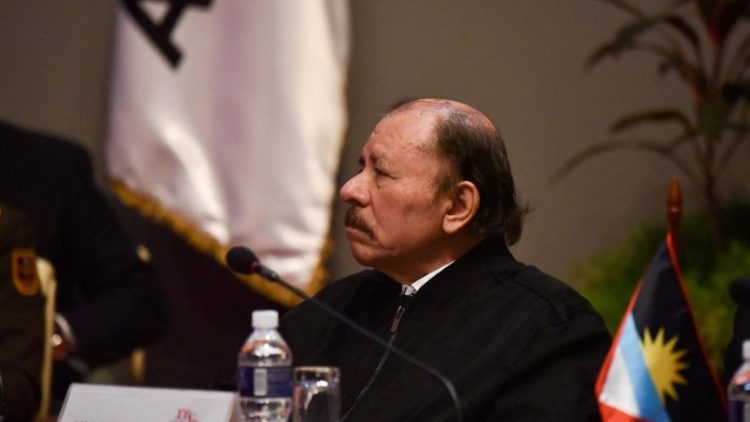
As the crackdown against the Catholic Church in Nicaragua continues, President Daniel Ortega’s regime declares the Jesuit religious order illegal and orders the confiscation of all its assets
By Lisa Zengarini
Despite worldwide protests and condemnation, the Sandinista regime’s crackdown against the Catholic Church and opposition continues unabated.
After expelling a community of Jesuit priests from their private residence close to the Central American University (UCA) in Managua, and confiscating the university, on Wednesday, 23 August, Nicaraguan authorities banned the entire Society of Jesus from the country and ordered the confiscation of all its assets, claiming the religious order had failed to comply with tax reporting.
Jesuit-run UCA confiscated and Jesuits evicted from their residence
The move comes one week after the government closed the Jesuit-run UCA in Managua which was a hub for 2018 protests against President Daniel Ortega’s regime, arguing it was a “centre of terrorism”.
The seizure, which adds the some 26 Nicaraguan universities the Sandinista regime has closed since 2021, was followed three days later by the eviction of a community of Jesuit priests from their residence nearby.
The measures have sparked strong reactions from Jesuit worldwide, including the Superior General of the order, Father Arturo de Sosa, SJ.
In a statement last week, Central American Province of the Society of Jesus described the government policy as a systematic violation of human rights “aimed at consolidating a totalitarian state.”
New condemnation from the Central American Jesuit Province
In a new statement released on Wednesday, 23 August, the Jesuit Province strongly condemned the “new aggression against the Jesuit Order in Nicaragua” and, again, appealed the Nicaraguan government to put an immediate end to its “systematic repression” and violation of human rights leading the country to a totalitarian state.
The statement further urged President Ortega and his wife, Vice-President Rosario Murillo to seek “a rational solution” to the contention “in which truth, justice, dialogue, respect for human rights, the rule of law”, while asking for « the respect of the freedom and total integrity » of the Jesuits working in the country and their collaborators.
Finally, the Jesuit Province of Central America expressd their closeness to the « thousands of victims » of government repression in Nicaragua « awaiting justice and reparation » and gratitude for world-wide support and solidarity » received during this crisis.
Worsening relations between Sandinista Government and Church
Lire la suite »
Nicaragua: que reste-t-il de la révolution promise?
Ortega désavoue les Evêques
« Cela m’a fait mal que mes évêques se soient comportés comme des putschistes, (…) ils se sont disqualifiés comme médiateurs, comme témoins (dans le dialogue), parce que leur message était le coup d’Etat », a déclaré, jeudi après-midi à Managua, le chef de l’Etat de 72 ans devant des milliers de partisans agitant des drapeaux rouge et noir du Front sandiniste de libération nationale (FSLN, gauche).
La Conférence épiscopale du Nicaragua (CEN), présidée par le cardinal Leopoldo Brenes, fait office de médiatrice dans la crise politique qui, depuis le 18 avril, a fait plus de 280 morts et quelque 2.000 blessées. Elle a proposé l’organisation d’élections générales anticipées en 2019 au lieu de 2021, date de la fin du mandat de Daniel Ortega. Ce dernier a rejeté ces propositions.
Nicaragua : le président annule la réforme à l’origine de manifestations meurtrières
Le président du Nicaragua Daniel Ortega a renoncé aujourd’hui à sa réforme controversée des retraites, point de départ d’une vague de manifestations qui a fait au moins 24 morts en cinq jours.
Lors d’une rencontre avec des chefs d’entreprise, le chef d’Etat de gauche a annoncé que l’Institut nicaraguayen de sécurité sociale (INSS) ne mettrait pas en oeuvre cette réforme, qui devait augmenter les contributions sociales des salariés comme des employeurs pour essayer d’équilibrer le système de retraites.
(avec AFP)
 TANIKO Madagascar