
china
56 Chinese Jets invade Taiwan’s airspace
Taiwan is preparing for war. 56 Chinese jets breached its airspace on Monday. The prospects of an invasion are growing. President Tsai Ing-wen has warned of ‘catastrophic consequences’. Ministry of Foreign Affairs, ROC (Taiwan) has called upon like-minded countries to unite.
Top US Commander fears Chinese invasion in Taiwan in next 6 years
Defend, dominate, deny: Declassified U.S. strategy shows vision for Indo-Pacific
The U.S. on Tuesday declassified a national security document that reveals details of the Trump administration’s strategy for the Indo-Pacific region, including Japan’s role as well as a plan to “deny,” “defend” and “dominate” China in the western Pacific.

Observers said the document’s release, just days before Donald Trump hands over the White House keys to President-elect Joe Biden and his team, may have been intended to bind the new president to the vision it laid out for the region while reassuring allies of a continued U.S. presence.
The rare decision to release and declassify the strategy, which provided the “overarching strategic guidance” for U.S. actions in the region, “demonstrates, with transparency, America’s strategic commitments to the Indo-Pacific and to our allies and partners,” national security adviser Robert O’Brien said in a statement accompanying it.
Typically, such documents remain classified for 30 years.
The statement and document itself also appeared to highlight the outsize role Japan played in its formation and after, touting the “strategic resonance” of Tokyo’s “Free and Open Indo-Pacific” concept and noting that the “growing alignment of strategic approaches in the region is perhaps nowhere more noteworthy than in the growth of the U.S.-Japan alliance during the last four years.”
Experts said these words made clear that allies, including Tokyo, had played a crucial role in the strategy’s creation.
“This confirms that U.S. strategic policy in the Indo-Pacific was in substantial part informed and driven by allies and partners, especially Japan, Australia and India,” Rory Medcalf, head of the National Security College at the Australian National University, wrote in an analysis for the Australian Strategic Policy Institute think tank.
Japan: Suga ends trip by decrying sea tensions, but denies seeking ‘Asian NATO’

Jakarta – Japan opposes any actions that will escalate tensions in the East and South China Seas, Prime Minister Yoshihide Suga said Wednesday as he wrapped up a trip to Vietnam and Indonesia, but he added Tokyo was not aiming at an “Asian NATO” to contain any specific country.
Suga’s four-day visit to the two Southeast Asian countries, his first overseas trip since taking office last month, is part of Japan’s efforts to bolster ties with key regional countries amid concerns about China’s growing assertiveness in the region.

“Japan is opposed to any actions that escalate tensions in the South China Sea. Let me stress anew the importance of all the countries concerning the South China Sea issues not resorting to force or coercion, but working toward peaceful resolutions of the disputes based on international law,” Suga told a news conference in Jakarta.
Suga’s Southeast Asia trip follows a meeting in Tokyo this month of the Quad, an informal grouping of India, Australia, Japan and the United States that Washington sees as a bulwark against China’s growing regional influence.
China has denounced the grouping of the four democracies as a “mini-NATO” aimed at containing its development.
“Our response in the South China Sea is not aimed at any one country,” Suga said, when asked if Japan wanted to create an Asian version of the North Atlantic Treaty Organization (NATO).
Suga must balance Japan’s deep economic ties with China with security concerns, including Beijing’s growing push to assert claims over disputed East China Sea isles. Some in his ruling party want to see a harder line, after ties warmed under his predecessor, Shinzo Abe.
“Japan is determined to defend its territory, territorial waters and air space,” Suga said, adding Japan also opposed actions that raised tensions in the East China Sea.
Several members of ASEAN (the Association of Southeast Asian Nations) have territorial disputes with China in the vital South China Sea, but are wary of alienating the group’s major economic partner and getting entangled in an intense confrontation between Washington and Beijing.
But some welcome Japan’s greater engagement in the region.
Suga agreed with Indonesian President Joko “Jokowi” Widodo on Tuesday to speed up talks on the export of Japanese defense gear and technology to Indonesia and have their defense and foreign ministers meet soon.
A day earlier, the Japanese leader and Vietnamese counterpart Nguyen Xuan Phuc also agreed in principle on a military equipment and technology export pact.
(source: japantimes.co.jp)
China’s insistence that Taiwan isn’t a country starts backfiring

The more China tells the world that Taiwan isn’t a country, the more Beijing’s adversaries are starting to treat it like one.
Ahead of Taiwan’s National Day on Saturday, Beijing’s embassy in New Delhi was reported to have issued a letter telling India’s media not to refer to it as a country or to Tsai Ing-wen as its president. Indians responded by helping the hashtag #TaiwanNationalDay go viral while banners with the Taiwanese flag were hung outside the Chinese Embassy.
“Hats off to friends from around the world this year, #India in particular, for celebrating #TaiwanNationalDay,” Taiwanese Foreign Minister Joseph Wu wrote in a Twitter post on Saturday.
Instead of marking Taiwan’s independence, a red line that Beijing has warned could trigger an invasion, the day commemorates a 1911 uprising in the central Chinese city of Wuhan against China’s last imperial dynasty. That led to the creation of the Republic of China, which leader Chiang Kai-shek then brought to Taiwan seven decades ago when he fled as the Communist Party took power.
For many in Taiwan today, the Republic of China seems like a historical relic with diminishing relevance for the democracy of 24 million people. Taiwan has long abandoned Chiang’s goal of reconquering what he knew as the mainland, and polls show that more and more Taiwanese don’t want any unification with China.
But celebrating the Republic of China is strategically useful for Tsai’s government. It allows her to sidestep the question of formal independence, avoiding a potentially devastating conflict with China while providing cover to create a distinct political and cultural identity for Taiwan — ultimately undermining President Xi Jinping’s goal of subsuming it under Communist Party rule.”

Pompeo ignorant on four areas on HK issues says China’s Foreign Ministry
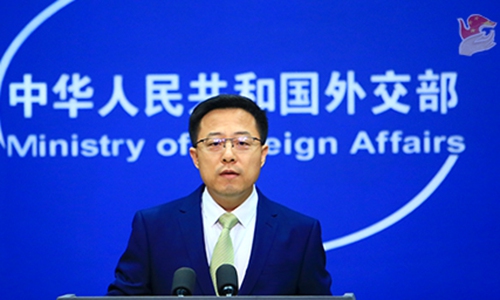
US Secretary of State Mike Pompeo fabricates and disseminates rumors so frequently that it reveals his ignorance and prejudice against China, the spokesperson of China’s Ministry of Foreign Affairs said, highlighting four things that embody Pompeo’s ignorance.
Zhao Lijian made the remarks at a Thursday press conference, when he was asked to comment on Pompeo’s statement that Beijing treats Hong Kong as « one country, one system, » and undermines the Hong Kong people’s human rights and basic freedom.
Zhao presented four things to explain Pompeo’s ignorance.
For one, he knows nothing about the national security law for Hong Kong, which clearly states that human rights should be respected and protected. « The law punishes the very few while protecting the majority. After the law was enacted, Hong Kong’s social order will be stabilized and the business environment will be improved, which will benefit the majority of Hong Kong residents and international investors. »
Global report: Fauci voices Covid-19 fears for Trump rally as São Paulo faces cemetery crisis
Rallies and protests present infection risk; Brazilian city to exhume bodies to free up more space; fresh domestic cases cause alarm in Beijing
Dr Anthony Fauci, a senior US infectious disease official, has warned of the dangers of holding Trump election rallies during the pandemic, adding that rising coronavirus hospitalisations in some states could get out of control unless robust contact-tracing regimes were in place.
Fauci warned there was a risk of either “acquiring or spreading” the virus for those who attend the president’s planned rally in Oklahoma next week, although he said he had not raised the issue with him.
(…)
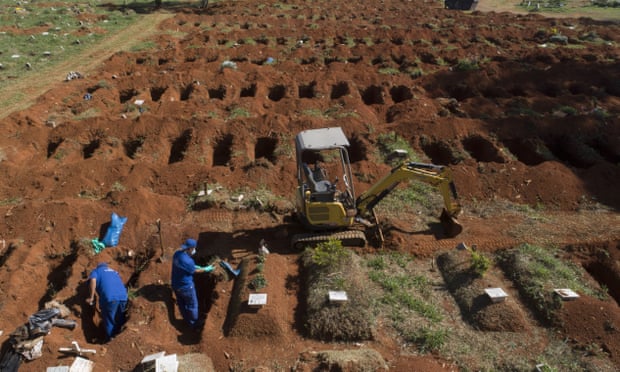
In Brazil, the city of São Paulo has said it will exhume bodies buried years ago and store their bagged remains in large metal containers in a bid to free up space during the crisis.
The municipal funeral service said in a statement on Friday the remains would be placed in numbered bags, then stored temporarily in 12 containers it has bought. The containers would be delivered to several cemeteries within 15 days.
The country marked a grim milestone the same day, overtaking the UK to become the country with the second-highest Covid-19 death toll in the world.
In Argentina, a pastor turned his church into a bar in protest at the uneven easing of restrictions in his Santa Fe province. Church leaders were dressed as waiters carrying Bibles on their trays in a mock service. Pastor Daniel Cattaneo said: “So, apart from the breaded veal headed for table four, here goes the word of God.”
India reported its biggest daily jump in cases on Saturday, adding 11,458 confirmed infections and taking the its total count to more than 300,000, according to data from the federal health ministry.
India is the fourth-worst affected country in the world, having passed the UK on Friday, with cases steadily increasingly despite a nationwide lockdown that began in late March and has since been loosened.
China reported 11 new cases on Saturday, including six domestic cases in the capital, Beijing, that raised concerns about a resurgence. Most of China’s cases in recent months have been overseas nationals tested as they returned home. The new cases have prompted Beijing officials to delay the return of students to primary schools and suspend all sporting events and group dining. City authorities on Friday also closed two markets visited by one of the known cases.
The first new case in Beijing after two months – who had no recent travel history outside the city – was reported on Thursday, and authorities confirmed two more infections the next day. The other five cases reported Saturday were brought in from overseas.
New Zealand has now gone for 22 days in a row without recording a new case. Following the recovery of an Auckland woman on Monday, it has no known active cases of Covid-19, and no one is in hospital with the virus.
Trump cuts all ties with WHO, continues to blast China for COVID-19 response and Hong Kong laws
U.S. President Donald Trump officially cut ties with the World Health Organization, continued to criticize China for its COVID-19 response and blasted the country for a new law targeting Hong Kong. Priviledges granted to Hong Kong to be suppressed.
Donald Trump choisit la guerre froide avec la Chine
Le président américain a acté la cassure en multipliant les gestes de défiance, notamment à propos de Hongkong. Sa détermination tranche avec la mansuétude dont il a longtemps fait preuve à l’égard de la Chine.
Entre la Chine et les Etats-Unis, l’heure est désormais à la guerre froide. Donald Trump l’a acté, vendredi 29 mai, en multipliant les gestes de défiance vis-à-vis de Pékin. Le président des Etats-Unis va ainsi lancer le processus de révocation des exemptions accordées à Hongkong, du fait de la remise en cause de son statut spécial par les autorités chinoises.
« Cette décision aura un impact sur l’ensemble des accords que nous avons avec Hongkong », a assuré Donald Trump, qui a qualifié de « tragédie pour le peuple de Hongkong, pour la Chine, et pour le monde entier » les atteintes contre l’autonomie concédée en 1997 par les autorités chinoises, lors de la rétrocession du territoire à la Chine par la Couronne britannique. Cette autonomie devait s’étendre pendant un demi-siècle. Pékin « n’a pas tenu sa parole », a assuré le président après le feu vert donné à une loi de sécurité nationale par le Parlement chinois. « La Chine a remplacé sa formule promise “un pays, deux systèmes”, par “un pays, un système” », a-t-il ajouté.
China rivalry may put the U.S. back in the coup business
Washington – By all accounts, the U.S. government was not involved in the failed plot this month to overthrow President Nicolas Maduro in Venezuela. One would hope that the Central Intelligence Agency could do better than a farcical scheme that was disowned by the Venezuelan opposition, penetrated by regime security forces and disrupted as soon as it began.

Yet this trivial episode invites us to think seriously about the role of covert intervention and regime change in U.S. policy. Just as the United States sought to undermine or topple unfriendly regimes during the Cold War, it may look to such methods again in its increasingly heated rivalry with China. Caution will be necessary: History tells us that while covert intervention can sometimes be a cost-effective tool of competition, it is fraught with risks and profound moral trade-offs.
Covert action came of age during the Cold War. In the late 1940s, when the CIA and National Security Council were born, the U.S. began developing a global capability for intervention under the cloak of secrecy. Over the succeeding decades, it would seek to destabilize or replace numerous governments that were slipping into the Soviet sphere or softening up their countries for communist influence. Lire la suite »
Most of China’s donations unable to reach Cuba due to embargoes: Cuban ambassador
More than 30 Chinese enterprises have either donated or supplied anti-virus materials to Cuba since the coronavirus outbreak began, but only a small number of them have successfully arrived in the country, the Cuban Ambassador to China told the Global Times in an exclusive interview.
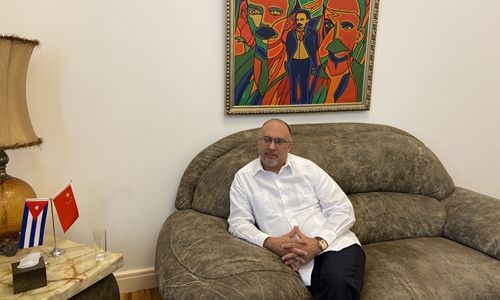
Ambassador Carlos Miguel Pereira said that the medical supplies previously donated by the Alibaba Foundation to help Cuba combat COVID-19 are still stranded in China due to sanctions imposed by the US.
The Cuban diplomat said that they are currently in close contact with Alibaba to work out other possible plans to solve the problem, including replacing the US company that was responsible for transporting the medical supplies to Cuba. The final arrangements have not yet been decided.
According to the official Weibo account of the Cuban Embassy in China, the Jack Ma foundation and Alibaba Foundation donated medical supplies, including face masks, test kits and respirators, to 24 Latin American countries including Cuba. But these supplies were unable to reach Cuba as scheduled because an American company that was responsible for shipping them rejected the order at the last minute.
« The reason was that the US government tightened its policy of economic, commercial and financial embargoes imposed on Cuba, thereby thwarting the enterprise from shipping the equipment to Cuba despite the fact that these medical supplies are urgently needed to fight the virus, » said the embassy on Weibo.
The post went viral and soon became a trending topic on Weibo, with many Chinese netizens expressing sympathy and support for the country.
Europe and China were on course for a reset. Coronavirus changed all that

(CNN) – Before coronavirus brought the world to its knees, 2020 was slated to be a crucial year for the European Union and China.
- ← Précédent
- 1
- 2
- 3
- 4
- Suivant →
 TANIKO Madagascar