El-Sisi, speaking at a joint news conference with Erdogan in Cairo, says Egypt seeks to raise trade volume with Turkey to $15bn over the next few years. Egypt’s el-Sisi says he looks forward to accepting President Erdogan’s invitation to visit Turkey in April to strengthen bilateral relations.
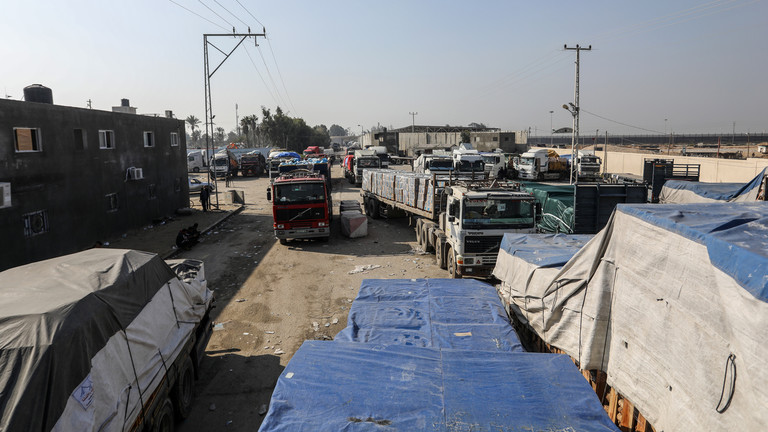
Israeli Prime Minister Benjamin Netanyahu aims to take full control of the Gaza-Egypt border zone, arguing that this is the only way to achieve the “demilitarization” of the Palestinian enclave and prevent cross-border attacks.
Speaking at a press conference in Tel Aviv on Saturday as Israel enters the 13th week of the war with Hamas, Netanyahu predicted that “the war will continue for many more months,” despite international pressure to end the hostilities.
He reiterated the plans to fully eliminate Hamas and achieve the release of all Israeli hostages, promising to ensure that Gaza no longer poses a threat to Israel and that there will be “no element in it that finances terrorism, educates its children for terrorism and pays the families of terrorists.”
Netanyahu added that there are “additional important missions” aimed at restoring security in the Israeli cities and settlements that fell victim to the devastating Hamas attack on October 7 and facilitating a safe return for residents.
“The Philadelphi Corridor – or to put it more correctly, the southern stoppage point [of Gaza] – must be in our hands. It must be shut. It is clear that any other arrangement would not ensure the demilitarization that we seek,” the prime minister said.
“As prime minister, I have rejected the international pressure aimed at stopping the war before we achieve these goals,” Netanyahu added. He also praised the US for approving the “supply of additional war materiel” to the Israel Defense Forces (IDF). Lire la suite »
A medical worker treats a covid-19 patient at a hospital in Cairo in 2021. (Fadel Dawod/Getty Images)
CAIRO — When a hospital in Britain offered Mohamed a new job in 2020, he didn’t have to think twice: The proposed salary was 40 times higher than what he was making at home.
Like other young doctors in Egypt, 34-year-old Mohamed had spent years in school and specialized training, only to be placed in a government hospital where he earned around $300 a month — barely enough to scrape by.
Mohamed spoke to The Washington Post on the condition that he be identified only by his first name, fearing government reprisals for criticizing the medical system.
By moving to the U.K, he joined more than 11,500 doctors who left Egypt’s public health sector between 2019 and 2022, many of them seeking better prospects abroad. Last year, more than 4,300 government-employed Egyptian doctors submitted their resignations, an average of 13.5 per working day.
The rapid exodus is fueling a shortage of qualified doctors in the country. The World Health Organization puts Egypt’s doctor-to-population ratio at 7.09 for every 10,000 people, well below its minimum recommendation of 10. The figure is 35 in the United States and double that in Sweden. But Egypt also lags behind some poorer nations, like Algeria (17) and Bolivia (10).
Mohamed said practicing medicine in Egypt felt like “hitting my head against a wall that never breaks.”
“I needed a place where I would wake up daily and care about nothing but supplying great medical care to my patients, and at the end of the month get paid enough to sustain a decent living,” he said. “I needed to leave.”
In Egypt, all medical graduates are mandated to work in the government sector for at least three, but up to five, years until they become specialists and can leave for better-paying work in private facilities.
During that time, they are paid 2,000 to 4,000 Egyptian pounds per month, a sum that has significantly decreased in value amid soaring prices and a recent currency devaluation. During the pandemic in March 2020, Egyptian President Abdel Fatah El-Sisi ordered a 75 percent increase in monthly pay, but the raises have not kept pace with the economic crisis.
A year ago, the exchange rate was around 15 pounds to the dollar. Now it has surpassed 30, leaving young doctors scrambling for side jobs in the private sector.
“How do they expect a person to survive [on that salary]? That is barely my transportation and breakfast costs for a month,” said Ekram El Azzazy, 28, a doctor in Cairo who works three jobs to make ends meet.
Ekram El Azzazy, a 28-year-old physician in Cairo, works three jobs to stay afloat. (Ekram El Azzazy)
She sleeps in hospital hallways. “Working seven days a week just to survive is really draining,” she lamented. Sometimes, she said, she has been so disoriented that she didn’t realize a patient had checked in or “why the patient’s family was screaming at me.”
The Doctors’ Syndicate medical association has blamed the exodus on low wages, as well as a poor work environment, including understaffed and under-resourced medical facilities.
Health Ministry spokesman Hossam Abdel-Ghaffar told The Post that Egypt has 5,426 primary-care units throughout the country, but only around half of them are “well-equipped,” with basic services such as radiology and a lab.
“For a time before, there was not enough care or attention paid to the primary-care units,” he said, adding that the ministry plans to renovate all such units by the end of next year.
Young doctors should be willing to make sacrifices, Abdel-Ghaffar said, because “the state bears 99.9 percent of the costs of their medical school fees.”
But efforts to make jobs in the industry more sustainable are not coming fast enough. And the shortage of medical staff in wealthier countries has made it simpler than ever for doctors in Egypt — and across the developing world — to find positions in Europe, the Persian Gulf region and the United States.
“It is more than easy for doctors in Egypt to leave,” said Ahmad Diaa, 34, an internal medicine resident in a Chicago hospital. “This is a problem that the government is not paying attention to.”
It took Diaa just two weeks of job hunting to land six offers outside Egypt.
In 2017, he accepted a position as a general practitioner in a primary care unit in Saudi Arabia. After just one year there, he had saved $20,000, which allowed him to travel to the United States to obtain his medical license.
In Saudi Arabia, Diaa said, his superiors understood that he had little experience and eased him into the job with basic tasks such as referring cases to hospitals and prescribing medications for clear symptoms.
The year before, fresh out of school in Egypt, he worked in a facility in the northern city of Monofeya that was in “depleted condition,” he said, where he was expected to shoulder much of the responsibility.
“It was a horrible experience. Without proper prior medical training, you are supposed to be responsible for a primary-care unit,” he said. “We had no ultrasound device, no X-ray, no lab.”
Late last year, Egypt’s Health Ministry opened several night clinics where doctors can work to earn additional income.
Ahmad Diaa, 34, left Egypt in 2017 to work at a hospital in Saudi Arabia. He works in Chicago now as a resident in internal medicine. (Ahmad Diaa)
But the government is aware, Abdel-Ghaffar said, that it is “racing against time” to slow the accelerating brain drain and keep young doctors in Egypt.
“I am willing to work at multiple places, one to learn and the other to barely make any money, but this all has to sustain a living,” El Azzazy said. “I need to eat.”
She tries to remind herself of all the reasons she loves Egypt: The late walks with friends, hearing her native language in the streets. It’s what made her stay even as “everyone else is leaving.”
She was once sure she would never join them. “But I am now considering it,” she said.



 TANIKO Madagascar