
Kristalina Georgieva
Le Maroc, un modèle en matière de construction sociétale et de développement (DG du FMI)

Rabat – Le Maroc, qui jouit d’une économie dynamique, est un modèle en matière de construction sociétale et de développement, a affirmé, lundi à Rabat , la Directrice Générale du Fonds monétaire international (FMI), Kristalina Georgieva.
“Le Maroc est un modèle au niveau de la gestion de la crise post-covid grâce à des actions gouvernementales ciblées et circonscrites dans le temps”, a indiqué Mme.Georgieva, lors d’un entretien avec le Chef du gouvernement, Aziz Akhannouch, en marge d’une visite officielle au Maroc dans le cadre des préparatifs des prochaines assemblées annuelles du Groupe de la Banque Mondiale et du FMI, qui se tiendront à Marrakech en octobre prochain, ainsi que pour le renforcement du partenariat existant entre le Royaume et le FMI.
A cette occasion, M.Akhannouch a rappelé les derniers préparatifs du Maroc pour abriter les assemblées annuelles du Groupe de la Banque Mondiale et du FMI, exprimant la fierté du Royaume pour avoir été choisi pour abriter une rencontre mondiale de l’envergure des assemblées annuelles du Groupe de la Banque Mondiale et du FMI, ce qui témoigne de l’intérêt considérable que les institutions financières internationales portent au Maroc, indique un communiqué du département du Chef du gouvernement.
Le Chef du gouvernement a relevé que cette manifestation offre l’opportunité de mettre en exergue les étapes importantes franchies par notre pays dans les différents domaines de développement, sous la conduite éclairée de SM le Roi Mohammed VI, et de faire connaitre les spécificités de la civilisation et de la culture marocaine, assurant que le Maroc, en étant l’hôte de ce rendez-vous important, représente l’ensemble du continent africain.
A cet égard, M.Akhannouch a passé en revue les grandes orientations de l’action gouvernementale, qui s’articule principalement autour de la relance économique, la généralisation de la protection sociale, la réforme fiscale, la réforme du secteur public, ainsi que la réforme du secteur financier.
Third of world economy to hit recession in 2023, IMF head warns
China’s lagging growth a key threat this year, IMF managing director Kristalina Georgieva said, while the US is ‘most resilient.’
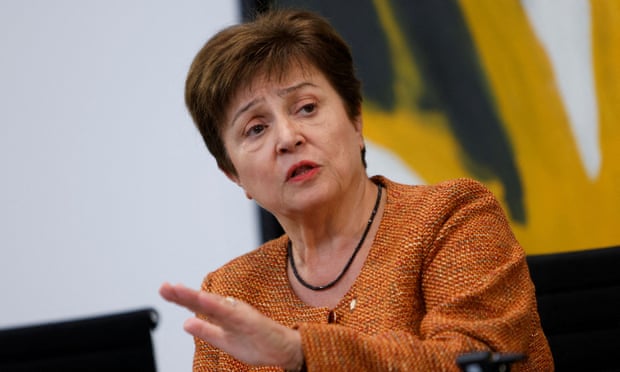
For much of the global economy, 2023 is going to be a tough year as the main engines of global growth – the US, Europe and China – all experience weakening activity, the head of the International Monetary Fund has warned.
The new year is going to be “tougher than the year we leave behind,” IMF managing director Kristalina Georgieva said on the CBS Sunday morning news program Face the Nation on Sunday.
“Why? Because the three big economies – the US, EU and China – are all slowing down simultaneously,” she said.
“We expect one-third of the world economy to be in recession. Even countries that are not in recession, it would feel like recession for hundreds of millions of people,” she added.
In October, the IMF cut its outlook for global economic growth in 2023, reflecting the continuing drag from the war in Ukraine as well as inflation pressures and the high interest rates engineered by central banks like the US Federal Reserve aimed at bringing those price pressures to heel.
Georgieva said that China, the world’s second-largest economy, is likely to grow at or below global growth for the first time in 40 years as Covid-19 cases surge following the dismantling of its ultra-strict zero-Covid policy.
“For the first time in 40 years, China’s growth in 2022 is likely to be at or below global growth,” Georgieva said.
Moreover, a “bushfire” of expected Covid infections there in the months ahead are likely to further hit its economy and drag on both regional and global growth, said Georgieva, who traveled to China on IMF business late last month.
“For the next couple of months, it would be tough for China, and the impact on Chinese growth would be negative, the impact on the region will be negative, the impact on global growth will be negative,” she said.
Meanwhile, Georgieva said, the US economy is standing apart and may avoid the outright contraction that is likely to afflict as much as a third of the world’s economies.
The “US is most resilient,” she said, and it “may avoid recession. We see the labour market remaining quite strong.”
“This is … a mixed blessing because if the labour market is very strong, the Fed may have to keep interest rates tighter for longer to bring inflation down,” Georgieva said.
The US job market will be a central focus for Federal Reserve officials who would like to see demand for labour slacken to help undercut price pressures. The first week of the new year brings a raft of key data on the employment front, including Friday’s monthly nonfarm payrolls report, which is expected to show the US economy minted another 200,000 jobs in December and the jobless rate remained at 3.7% – near the lowest since the 1960s.
(source: theguardian.com)
L’Ukraine va bénéficier d’un prêt du FMI
Satisfait par les actions du président Volodymyr Zelensky, le FMI va prêter près de 5 milliards d’euros à l’Ukraine.

Le Fonds monétaire international (FMI) a annoncé samedi avoir trouvé un accord de principe avec l’Ukraine en vue d’un prêt d’environ 5,5 milliards de dollars, pour relancer une économie en difficulté. Le prêt, prévu sur trois ans, doit encore être approuvé par la direction et les États membres du FMI.
Il dépend également de «la mise en oeuvre d’un ensemble d’actions préalables», dont le renforcement de l’indépendance de la justice et la lutte contre la corruption, a indiqué dans un communiqué la directrice générale du Fonds, Kristalina Georgieva, à l’issue d’une conversation téléphonique avec le président ukrainien Volodymyr Zelensky.
(lessentiel.lu avec AFP)
 TANIKO Madagascar