
Vietnam
Pasteur Network Annual Meeting 2025 – L’Institut Pasteur de Madagascar brille au Vietnam
La Grande île a pris part au Pasteur Network Annual Meeting (PNAM) 2025, organisé du 21 au 24 octobre à Hô-Chi-Minh-Ville, au Vietnam.

Collaboration entre chercheurs
L’Institut Pasteur local et le Réseau Pasteur ont coorganisé cette rencontre internationale. L’événement a rassemblé des dirigeants, chercheurs et experts en santé publique de plus de trente instituts. Cette édition a renforcé les liens scientifiques entre les pays membres. Les participants ont échangé sur la préparation aux épidémies, les maladies sensibles au climat et les innovations en santé publique. À travers des présentations, ateliers et discussions, le PNAM 2025 a favorisé la collaboration et l’émergence de nouvelles approches pour la recherche mondiale.
L’Institut Pasteur de Madagascar (IPM) a mis en avant ses jeunes chercheurs. Le Dr Antsa Rakotonirina, membre de l’unité d’Entomologie Médicale, a présenté une communication intitulée « Molecular detection of tick-borne pathogens in ticks from Madagascar: Public Health implications ». Cette étude, réalisée dans le cadre des programmes GHS-RISE (USAID) et AFRICAM Madagascar (Prezode), explore la détection moléculaire des agents pathogènes transmis par les tiques.
Focus sur la santé publique
Le projet renforce la surveillance des maladies émergentes et améliore la compréhension des risques liés aux tiques à Madagascar. Ces recherches soutiennent la prévention et la réponse rapide face aux menaces sanitaires. Grâce à ces travaux, le pays contribue à la lutte contre les maladies vectorielles en Afrique et dans le monde. Le PNAM 2025 a également mis en lumière l’initiative « 40 Under 40 », dédiée à quarante jeunes chercheurs de moins de quarante ans. Ce programme valorise les scientifiques engagés dans la recherche sur les arbovirus, le microbiote, le climat et la santé.
En promouvant ces talents, le Réseau Pasteur encourage la relève scientifique et l’innovation. Des tables rondes, panels et ateliers ont animé les journées. Les échanges ont porté sur la fabrication de vaccins, la participation communautaire à la recherche et le rôle des femmes dans les sciences. Ces discussions ont nourri des pistes concrètes pour une recherche plus inclusive et durable.
(source: moov.mg)
En déplacement à Hanoï, Emmanuel Macron appelle à préserver un ordre mondial «fondé sur le droit»
Arrivé dimanche soir dans la capitale vietnamienne, Emmanuel Macron continuera sa tournée jusqu’à vendredi, en Indonésie puis à Singapour.
Dans un contexte mondial de «grands déséquilibres», le président de la République Emmanuel Macron a appelé à «préserver un ordre fondé sur le droit», lundi au Vietnam, première étape de sa tournée en Asie du Sud-Est. «Dans un moment à la fois de grands déséquilibres et de retour de discours de puissances ou d’intimidations», l’ordre international «impose que nous agissions ensemble pour préserver un ordre fondé sur le droit, condition sine qua non à toute prospérité», a rappelé le dirigeant, au cours d’une déclaration à la presse aux côtés de son homologue vietnamien Luong Cuong, à Hanoï.
Le dirigeant a présenté la France comme une alternative fiable au Vietnam, pris en tenaille entre Washington, qui menace d’imposer une surtaxe prohibitive sur ses exportations à destination du marché américain, et Pékin, son allié de longue date avec lequel Hanoï partage des différends territoriaux en mer de Chine méridionale. Ces enjeux accompagneront Emmanuel Macron tout au long de sa visite en Asie du Sud-Est, avec des arrêts prévus en Indonésie et à Singapour cette semaine. Arrivé dimanche soir à Hanoï avec son épouse Brigitte Macron, le président a insisté sur la vision commune partagée avec le Vietnam, pays de cent millions d’habitants à la croissance dynamique, qui partage un passé colonial souvent douloureux avec Paris.
Quelque treize accords ont été signés lundi, notamment sur l’énergie nucléaire, un secteur crucial pour le pays asiatique, dépendant des énergies fossiles, qui cherchent à répondre aux besoins croissants de sa population, ainsi que dans les transports et les satellites. La compagnie low-cost Vietjet Air a aussi annoncé passer commande pour 20 avions gros-porteurs Airbus A330-900, qui s’ajoutent à un premier contrat similaire de 20 aéronefs passé l’an dernier avec le géant européen de l’aéronautique. «C’est bien une nouvelle page qui s’écrit entre nos deux pays (…) Une volonté d’écrire une page encore plus ambitieuse de la relation entre le Vietnam et la France, entre l’Asean et l’Union européenne», a insisté Emmanuel Macron.
Nouvelle commande d’Airbus
Après un hommage dans la matinée à la mémoire des combattants de la guerre d’Indochine qui se sont battus de 1946 à 1954 contre la France, pour l’indépendance, Emmanuel Macron a rencontré son homologue vietnamien Luong Cuong. Le chef de l’État, dont c’est la première visite au Vietnam, doit être reçu plus tard par le secrétaire général du Parti communiste To Lam, qu’il avait lui-même accueilli à Paris en octobre. Le chef du parti, avec lequel il déjeunera au temple de la Littérature, monument dédié à Confucius et lieu emblématique de la culture vietnamienne, est considéré comme le dirigeant le plus puissant du pays, où les organisations de défense des droits dénoncent une répression accrue de toute voix critique du pouvoir.
La semaine dernière, l’ONG Human Rights Watch a exhorté Emmanuel Macron dans une lettre à «faire pression» publiquement sur le gouvernement vietnamien pour qu’il «libère sans condition toutes les personnes détenues pour avoir exercé leurs droits à la liberté d’expression, d’association, de religion et de réunion». Une telle interpellation n’est pas dans les usages du président français qui assure régulièrement préférer évoquer ces sujets sensibles à huis clos. D’autant qu’au Vietnam, l’Élysée espère «renforcer les coopérations dans les secteurs stratégiques tels que l’énergie, les transports et la défense».
Et le chef de l’État entend marteler son offre de «troisième voie» à ce pays d’Asie-Pacifique particulièrement exposé à la concurrence sino-américaine. «Le Vietnam est vraiment sur la première ligne de toutes les tensions qui croissent en mer de Chine méridionale», où Pékin se fait de plus en plus offensif dans ses revendications territoriales, glisse un haut responsable de la diplomatie française. Mais il est aussi en pleines négociations pour tenter d’échapper à la forte taxe douanière de 46% imposée puis suspendue par Donald Trump, alors que les États-Unis sont le plus grand marché des exportations de l’industrie manufacturière vietnamienne.
Des «règles» plutôt que la «jungle»
Énoncée dès 2018, déjà vantée dans de multiples déplacements en Inde, dans l’océan Pacifique ou dans l’océan Indien, la «stratégie indo-pacifique» d’Emmanuel Macron consiste à proposer une troisième voie aux pays de la région. Et elle trouve selon Paris toute sa pertinence depuis le retour de Donald Trump à la Maison Blanche avec ses menaces de guerre commerciale.
De manière plus ou moins subliminale, le président français devrait avoir un message pour chacun. Pour le président américain, en défendant les «règles du commerce international» plutôt que la loi de la «jungle», selon un de ses conseillers. Pour son homologue chinois Xi Jinping, qu’il a appelé avant son départ à garantir une «concurrence équitable», en martelant que la France est un partenaire «respectueux» de «la souveraineté» des pays de la région. Et aussi pour le président russe Vladimir Poutine, en affirmant aux pays comme le Vietnam ou l’Indonésie, longtemps tournés vers Moscou notamment pour leurs armements, mais qui cherchent à diversifier leurs fournisseurs, que la Russie, par la guerre qu’elle mène en Ukraine avec le soutien de soldats nord-coréens, «déstabilise l’Asie» et non seulement l’Europe.
Au Vietnam, cette posture de «puissance d’équilibre» peut trouver un écho: le pays veille lui-même à garder un certain équilibre dans ses relations avec la Chine et les États-Unis, afin de maximiser ses intérêts commerciaux, dans la lignée de sa «diplomatie du bambou».
(source: lefigaro.fr)
The Entire History of the Vietnam War | 1862 – 1975 (Documentary)
The history of the Vietnam War encompasses a complex series of conflicts spanning much of the 20th century, rooted in Vietnam’s long-standing struggle for independence and shaped by the global tensions of the Cold War. The region that is now Vietnam has been inhabited for thousands of years, with early states such as Văn Lang and Âu Lạc forming the foundations of Vietnamese civilization. For over a millennium, Vietnam was under Chinese rule, though distinct cultural and political identities gradually developed during periods of resistance and partial autonomy.
Vietnam gained full independence in the 10th century under the Ngô dynasty and maintained its sovereignty through successive dynasties until French colonization in the mid-19th century. The French established control over much of Southeast Asia, forming French Indochina in the 1880s. During this period, Vietnamese resistance movements emerged, most notably the rise of the nationalist and communist leader Hồ Chí Minh, who founded the Indochinese Communist Party in 1930.
Following Japan’s occupation of Vietnam during World War II, the country declared independence in 1945 under Hồ Chí Minh, leading to the First Indochina War between the communist-led Viet Minh and French colonial forces. The conflict ended in 1954 with the Geneva Accords, which temporarily divided Vietnam at the 17th parallel into a communist North and a non-communist South, pending national elections that never took place.
The division set the stage for the Vietnam War, known in Vietnam as the Resistance War Against America. Beginning in the late 1950s, the North Vietnamese government and its southern allies, the Viet Cong, waged an insurgency against the Republic of Vietnam (South Vietnam), supported by the United States and other anti-communist allies. American involvement escalated after the Gulf of Tonkin incident in 1964, leading to a massive deployment of U.S. troops and widespread aerial bombardment.
Throughout the 1960s and early 1970s, the conflict intensified. Major events such as the Tet Offensive in 1968 and revelations of atrocities like the My Lai Massacre eroded American public support. The war also prompted widespread protests and social unrest in the United States and beyond. After years of intense combat, peace talks, and a gradual withdrawal of U.S. forces under the policy of « Vietnamization, » the Paris Peace Accords were signed in 1973.
Despite the accords, fighting continued, and in 1975, North Vietnamese forces captured Saigon, bringing an end to the war and unifying Vietnam under a communist government. The conflict resulted in the deaths of an estimated 2–3 million Vietnamese and over 58,000 U.S. soldiers, leaving deep physical and psychological scars on both nations.
In the decades following the war, Vietnam underwent significant reconstruction and economic reform, transitioning from a centralized planned economy to a socialist-oriented market economy in the 1980s. Relations with the United States were normalized in 1995. Today, Vietnam is a rapidly developing country, though the legacy of the war remains deeply embedded in its society, environment, and national identity. The history of the Vietnam War reflects a broader narrative of colonial resistance, ideological conflict, and the lasting human cost of war in the modern era.
Chinese FM strongly opposes Vietnam’s unilateral claims on the South China Sea
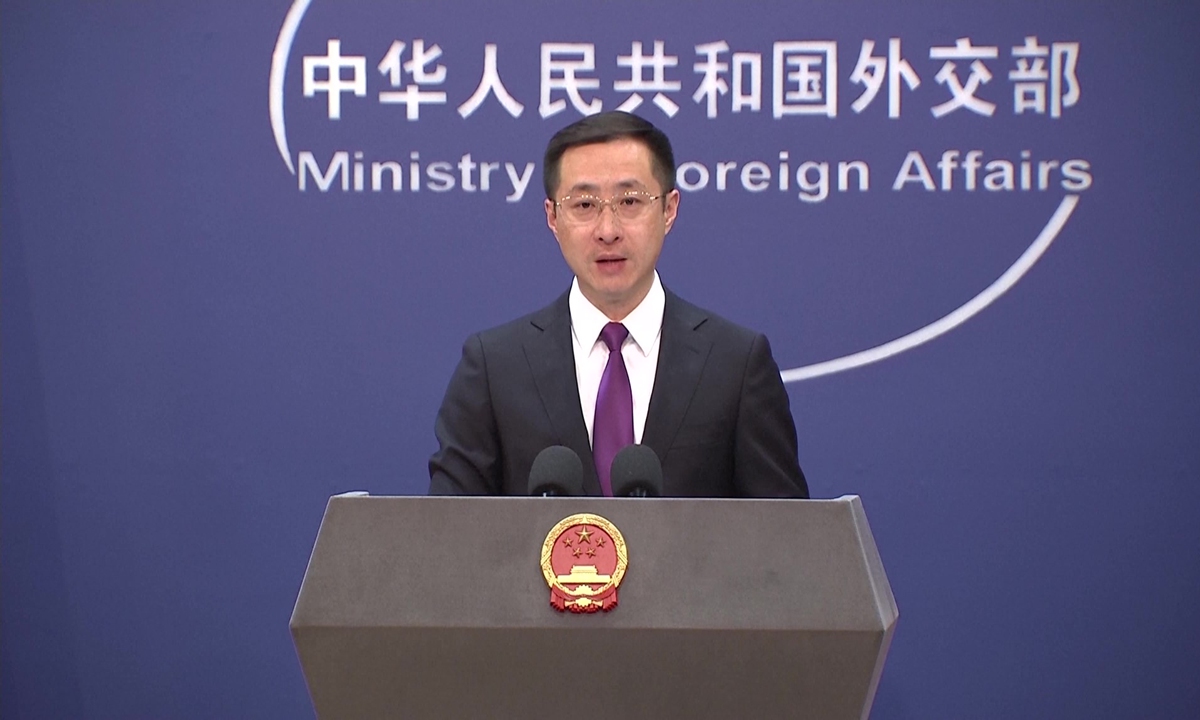
Vietnam unilaterally presented to the United Nations Commission on the Limits of the Continental Shelf (CLCS) its Submission on the Limits of the Extended Continental Shelf in the South China Sea. The claims made by Vietnam cover parts of China’s Nansha Qundao, which infringes on China’s territorial sovereignty and maritime rights and interests, Chinese Foreign Ministry spokesperson Lin Jian said on Thursday.
China firmly opposes it and has made serious protests to Vietnam, said Lin.
The claims violate international law including the UN Charter and the UN Convention on the Law of the Sea (UNCLOS), and breach the Agreement on Basic Principles Guiding the Settlement of Sea-related Issues between China and Vietnam and the Declaration on the Conduct of Parties in the South China Sea jointly signed by China and ASEAN countries, including Vietnam, said Lin.
According to the Rules of Procedure of the CLCS, submissions will not be considered where a dispute exists, which means the CLCS will not examine or qualify relevant submissions of Vietnam and the Philippines on delimitation. Such submissions do not have any practical effect but will only accentuate differences and exacerbate frictions, which will in no way help resolve the disputes, according to the spokesperson.
Japan to expand security assistance framework to Vietnam, Djibouti, sparking concerns
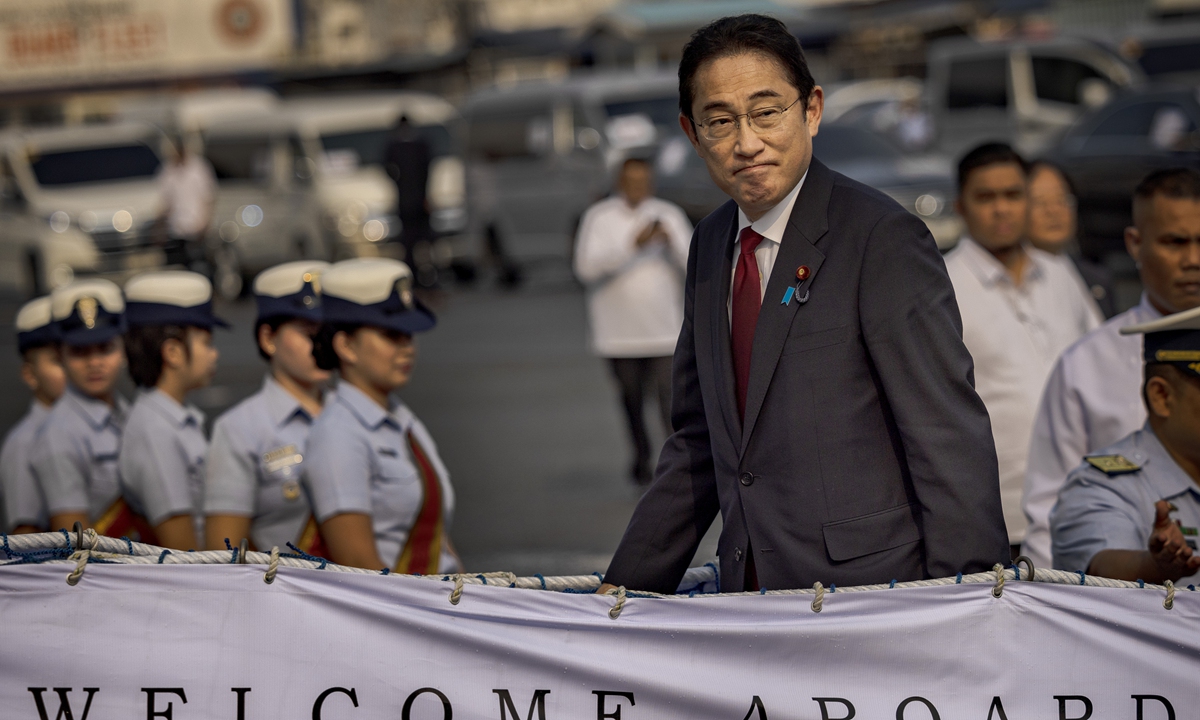
Japan’s Prime Minister Fumio Kishida boards the BRP Teresa Magbanua ship at the Philippine Coast Guard headquarters on November 4, 2023, in Manila, Philippines. Photo: VCG
Japan is considering providing defense equipment to Vietnam and Djibouti under a new security assistance framework after a similar move with the Philippines, Japanese media outlet NHK reported on Monday. This new framework of cooperation clearly targets China, but it will very likely end up as wishful thinking, experts noted on Tuesday.
Through the Official Security Assistance (OSA) framework, Japan earlier agreed with the Philippines that Tokyo will provide Manila with surveillance radar systems. Vietnam and Djibouti are the next candidates to receive OSA from Japan during the fiscal year that begins in April 2024, according to NHK.
The OSA framework, officially implemented in April this year, is different from the Official Development Assistance (ODA) previously provided by Japan to developing countries for non-military purposes only. Although Japan claimed that the new framework is designed to provide defense equipment to « Japan’s like-minded countries » as a way to « deepen security cooperation, » its actions do not adhere to its claims.
The selection of candidates such as the Philippines and Vietnam in the South China Sea reveal Japan’s real ambition – creating security threats against China, analysts noted.
In recent years, especially since current Japanese Prime Minister Fumio Kishida took office, Japan has been determined to antagonize China, Lü Chao, director of the Institute of US and East Asian Studies under Liaoning University, told the Global Times on Tuesday. « It is guided by the active promotion of the US’ so-called Indo-Pacific Strategy, and was boosted after the Camp David summit between the US, Japan, and South Korea. »
Lü said « China is clearly targeted as an enemy country in the framework. »
Japan: Suga ends trip by decrying sea tensions, but denies seeking ‘Asian NATO’

Jakarta – Japan opposes any actions that will escalate tensions in the East and South China Seas, Prime Minister Yoshihide Suga said Wednesday as he wrapped up a trip to Vietnam and Indonesia, but he added Tokyo was not aiming at an “Asian NATO” to contain any specific country.
Suga’s four-day visit to the two Southeast Asian countries, his first overseas trip since taking office last month, is part of Japan’s efforts to bolster ties with key regional countries amid concerns about China’s growing assertiveness in the region.

“Japan is opposed to any actions that escalate tensions in the South China Sea. Let me stress anew the importance of all the countries concerning the South China Sea issues not resorting to force or coercion, but working toward peaceful resolutions of the disputes based on international law,” Suga told a news conference in Jakarta.
Suga’s Southeast Asia trip follows a meeting in Tokyo this month of the Quad, an informal grouping of India, Australia, Japan and the United States that Washington sees as a bulwark against China’s growing regional influence.
China has denounced the grouping of the four democracies as a “mini-NATO” aimed at containing its development.
“Our response in the South China Sea is not aimed at any one country,” Suga said, when asked if Japan wanted to create an Asian version of the North Atlantic Treaty Organization (NATO).
Suga must balance Japan’s deep economic ties with China with security concerns, including Beijing’s growing push to assert claims over disputed East China Sea isles. Some in his ruling party want to see a harder line, after ties warmed under his predecessor, Shinzo Abe.
“Japan is determined to defend its territory, territorial waters and air space,” Suga said, adding Japan also opposed actions that raised tensions in the East China Sea.
Several members of ASEAN (the Association of Southeast Asian Nations) have territorial disputes with China in the vital South China Sea, but are wary of alienating the group’s major economic partner and getting entangled in an intense confrontation between Washington and Beijing.
But some welcome Japan’s greater engagement in the region.
Suga agreed with Indonesian President Joko “Jokowi” Widodo on Tuesday to speed up talks on the export of Japanese defense gear and technology to Indonesia and have their defense and foreign ministers meet soon.
A day earlier, the Japanese leader and Vietnamese counterpart Nguyen Xuan Phuc also agreed in principle on a military equipment and technology export pact.
(source: japantimes.co.jp)
 TANIKO Madagascar